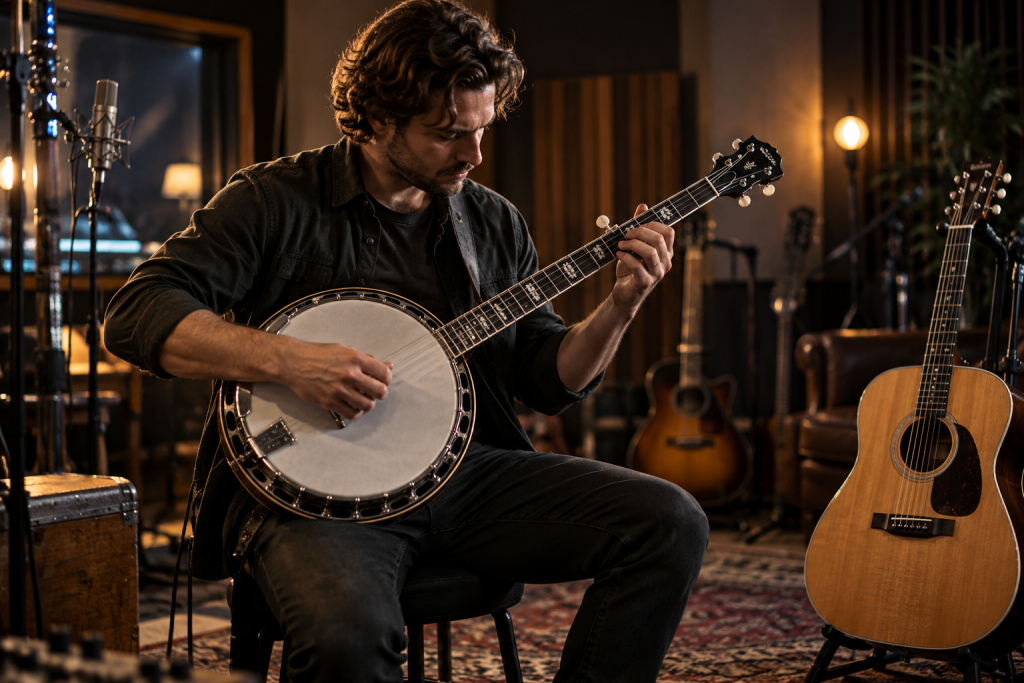
The first time I tried to play a banjo roll on guitar, my right hand locked up somewhere around the third note. I had the pattern in my head. My fingers just refused to cooperate. That gap between knowing a roll and playing it is the whole lesson, and it is why I now use banjo rolls as a warm-up even on days when I have no intention of touching a banjo.
If you play guitar and want a right-hand workout that actually changes how your picking hand behaves, rolls are about as efficient as it gets. They borrow a logic that guitarists rarely practise, and the transfer runs in both directions. Here is how I approach it and what I have found works in a real room.
What a roll actually is, in guitar terms
A banjo roll is a repeating right-hand pattern that keeps the strings moving in a steady stream of notes. The classic three-finger rolls (forward, backward, forward-reverse) cycle through the strings in a fixed order while the left hand changes chords underneath. The point is not speed. The point is that the picking hand runs on autopilot so the fretting hand can concentrate on harmony.
On guitar, the closest thing most of us do is a Travis-style alternating thumb with fingers picking melody notes. That is a good foundation, but a banjo roll is stricter. The pattern is fixed, and you repeat it until it becomes reflex. That strictness is exactly what makes it a workout.
Why it transfers to guitar at all
Guitarists tend to pick in ways tied to the phrase: downstroke here, upstroke there, adjust for string crossing. A roll breaks that habit. You commit to a sequence and force the hand to solve the string-crossing problem mechanically instead of musically. Over a few weeks, that mechanical confidence shows up in ordinary flatpicking and fingerstyle.
There is a second payoff that is less obvious. Rolls demand a locked, repeatable motion, and once a motion is locked, you stop thinking about it as a set of parameters and start feeling it as one gesture. The audiofanzine piece on hardware versus software makes the same point about physical tools: with a real object, “we don’t think in terms of parameters, but in terms of tactile sensations,” and the resistance of a knob becomes an extension of the arm. A roll does that for your picking hand. The pattern stops being six separate decisions and becomes one physical loop.
The three rolls I start every student on
I keep it to three patterns at first. More than that and the hand never settles.
- Forward roll: thumb on the lowest string of the shape, index on the next, middle on the next, repeat. On guitar I map it to the three lowest strings of a chord voicing and let the left hand slide between two chords.
- Backward roll: the same three fingers in reverse order. This one exposes every weakness in your middle finger. Expect it to feel wrong for a fortnight.
- Forward-reverse: thumb, index, middle, index, thumb, index, middle. It sounds like a machine and teaches the hand to reverse direction without a stumble.
Play each one slowly enough that every note is clean and the timing is dead even. A metronome at 60 to 70 bpm is plenty. Speed is the last thing to add and the first thing students chase, which is backwards.
The mistakes I made (and still catch myself making)
My first error was letting the pattern drift. I would start a clean forward roll and by the fourth repetition my thumb had wandered to a different string. The fix was boring: play one bar, stop, check the pattern, restart. Slow repetitions with a reset in between built the loop faster than long sloppy runs.
My second error was tensing the wrist. A roll should feel loose and almost lazy, driven from the knuckles rather than clamped from the forearm. If your hand aches after two minutes, you are gripping, not rolling.
The third error was treating it as a speed drill. It is not. It is a coordination drill. The notes should be even before they are fast, and evenness at a slow tempo is what carries over to actual playing.
Where the transfer actually shows up
After a few weeks of daily rolls, I noticed two changes. My flatpicking crossings got cleaner, because my hand had learned to move between strings without re-aiming. And my fingerstyle patterns stopped falling apart when I changed chords, because the picking hand no longer cared what the left hand was doing.
There is a useful parallel in double tracking here. The majormixing guide insists you record a new take rather than copy-paste, because the small imperfections are what make the doubled part sound alive. Rolls work the same way: you are not aiming for a sterile, identical repetition. You are aiming for a steady, living loop where the timing breathes a little but never breaks. Consistency over perfection, in both cases.
Building it into a practice routine
Five minutes is enough to start. I do one roll per chord change, two chords, slow tempo, and I stop when the pattern gets sloppy rather than pushing through. Ten minutes of clean work beats thirty minutes of fighting the hand.
Once the three rolls feel automatic, start moving them across chord shapes. A forward roll over a C shape, then a G shape, then back. The left hand does the thinking, the right hand holds the pattern. That is the whole skill in one exercise.
Is it worth it for a guitarist?
Yes, with a caveat. If you only ever strum chords, rolls will feel like a detour, because the technique lives in fingerstyle and crosspicking territory. But if you flatpick melodies, play fingerstyle, or just want a right hand that obeys you, rolls are one of the most direct ways to get there.
The banjo players I have learned from treat these patterns as basic literacy. Guitarists tend to skip them and wonder why their picking hand stalls on fast passages. The fix is unglamorous and it works. Pick up the pattern, slow it down, and let the hand learn what the head already knows.