Six months is the point where gear stops being new. The presets you built in week one have survived a few rehearsals, a handful of gigs, and at least one session where something refused to work and you had to think on your feet. That is the test I care about. Not the spec sheet, not the launch video.
The Fender Tone Master Pro has been on my board for half a year now, mostly in a working cover band and a few studio dates where I needed reliable amp tones without hauling a head down a flight of stairs. Some of it has held up beautifully. Some of it I have made peace with. A couple of things still irritate me. Here is the honest ledger.
What a modeling floor unit actually has to survive
Before the specifics, it helps to name what this category is really for. A modern multi-effects board is not one pedal. It is a small computer that has to do several jobs at once: amp and cab simulation, a pedalboard of effects, routing for a real rig, and switching that feels instant under your foot on a dark stage.
When I tested a board in the Line 6 Helix range, the architecture was telling: two DSPs, each managing its own signal chain, with up to two amps and cabs per line plus the other effects alongside, and the ability to run two independent chains from the available inputs. (Source: Audiofanzine’s Helix Stadium review.) That arrangement is the standard the whole category gets held to. Two lines, plenty of blocks, and enough headroom that switching a group of effects on and off mid-song does not cause a hiccup or a drop-out. The Tone Master Pro lives or dies by the same rules.
The amp models: where it earns its place
This is the part I stopped worrying about around month two. The clean Fender-style models in particular are the reason the unit stays on my board. They take a drive pedal in front the way a real amp does, and they respond to pick attack and guitar volume in a way that a flat, compressed model never quite manages.
What matters over six months is consistency. A preset I built in March still sounds like the same preset in September after a firmware update, which is not a given with modeling gear. The amp and cab section is the solid foundation, and every other decision I make on this board leans on it.
I will say the high-gain models are not where I reach first. If your set is built around tight modern metal, there are dedicated units and plugins that do that specific thing with more authority. For roots, blues, country, and indie, the Tone Master Pro is on comfortable ground.
The effects: good, not the reason to buy
The effects are competent, and that is my honest read after six months. The delays and reverbs are perfectly usable, and the modulation options cover the usual ground. But I have never once plugged in a phaser or a tremolo and thought, this is why I bought this thing.
Where a board like this really shows its value is routing. A Helix-class unit offers send and return loops, independent outputs for different destinations, and MIDI in and out, which opens up advanced setups where effects can be split across chains. (Source: Audiofanzine’s Helix Stadium review.) I have used the Tone Master Pro’s routing in a simpler way, mostly a single chain into the house, and it has been reliable. I have not pushed it to the edge, so I will not pretend to have opinions about the extremes of its routing that I have not tested.
Footswitches, the screen, and the reality of a dark stage
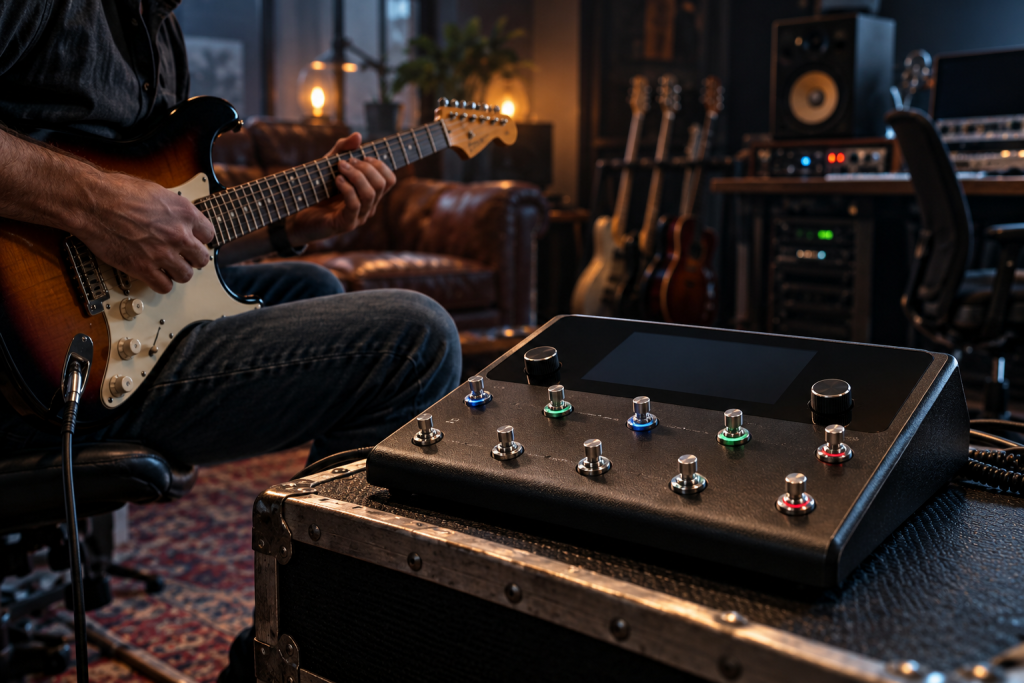
Here is what six months teaches you that a demo never will. The touchscreen is lovely in the studio. On a dimly lit stage with one hand on the guitar, it is not where your attention should be. The physical footswitches and the expression pedal are what you actually live with.
The switch spacing works for me. I have big feet and I have not hit the wrong patch yet during a song, which is more than I can say for some boards. The scribble strips are readable at a glance, which matters more than any on-screen graphic once the lights go down.
My one consistent gripe is menu depth. Anything beyond the most common tweaks means diving into the screen, and that is a studio activity, not a soundcheck activity. I have learned to build presets at home and treat the gig as read-only. That is the right way to use it, but the unit does not push you toward that workflow. You have to impose it on yourself.
What I did not expect to care about
Commitment. When you build a preset and commit to it, you stop fiddling. A reviewer writing about hardware versus software put this well: in a DAW the temptation to keep adjusting every parameter up to the last minute is always there, but when you commit a take from a piece of hardware, the sound is frozen and you move forward. (Source: Audiofanzine’s piece on hardware as a choice.) The same logic applies to a preset you build and then leave alone at the gig.
Having a fixed set of patches that just work has made me play better. I stop tweaking and start playing. That is not a feature on any spec sheet, but it is the most useful thing the board has given me over six months.
The annoyances, unfiltered
Firmware updates are the fun part and the frustration at the same time. New models and fixes arrive, which is welcome. The trade-off is that a small update can shift the feel of a preset you had dialled in, and you learn to save a fallback. It is not a dealbreaker. It is a routine to build.
The unit is not light. If you are carrying it to a gig plus a guitar and an amp for the odd date, your back will notice. That is the physical cost of a floor unit with a real screen and real processing inside.
And the effects, again. They are good enough to gig. They are not the reason to pick this over a competitor. If you already own a pedalboard of drives and delays you love, the Tone Master Pro makes a fine amp-and-routing brain for that board rather than a replacement for it.
Who this has worked for, and who it hasn’t
After six months my verdict is narrower than a launch review would give you. It has held up as an amp platform and a reliable live rig. It has not won me over as an all-in-one effects solution, and I no longer expect it to.
If your playing leans on clean and edge-of-breakup amp tones and you want a dependable floor unit that sounds the same at every gig, this board has earned its place. If your sound is built on extreme high gain, or you live for deep menu-driven sound design, look at the alternatives first. The Tone Master Pro rewards people who build a preset, trust it, and play. That is exactly what I have done for half a year, and it is still on my board.