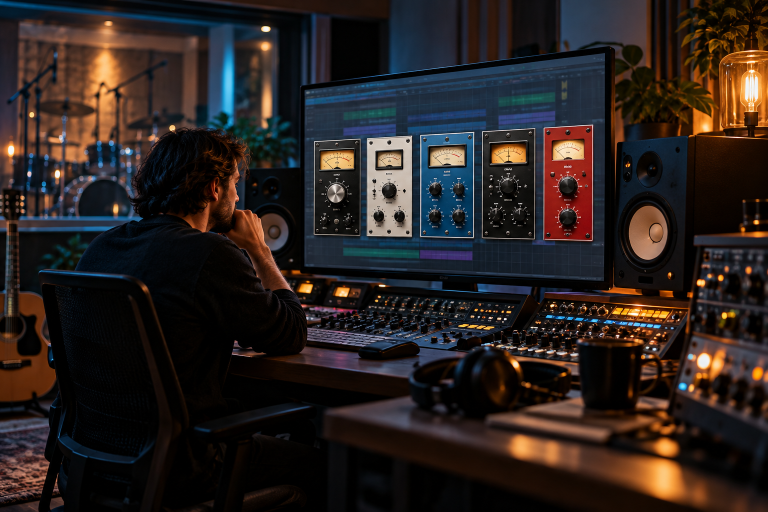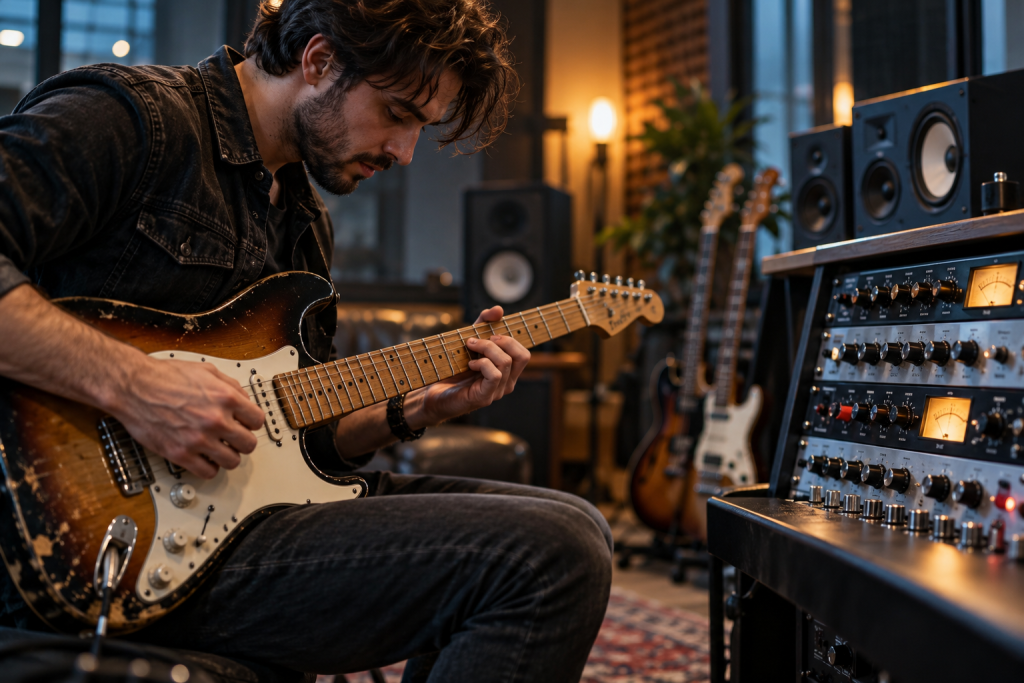
I recorded the same fifteen-second phrase thirty times last week. Same guitar, same pick, same room, same mic. The only thing changing was the compressor plugin. It was a dull afternoon and I wanted to settle an argument with myself about which compressors actually preserve the pick chirp and which ones smooth it into a soft, characterless lump.
Guitar is unforgiving with compression. A flatpick hitting bronze or steel is a transient-heavy event, and most compressors are built with vocals, drums, or full mixes in mind. They grab the front edge and either let it through or crush it. If a compressor has a fixed 10 ms attack, your pick is already collapsing before the circuit has reacted. That is what kills the attack, not the ratio and not the makeup gain.
So I took a few that I actually use and put them through the test. My criteria: does the pick stay intact at 4 to 6 dB of gain reduction, does the string body keep its shape, and does the release feel musical on held chords. Easy to write down. Harder to find.
Why guitar transients fight most compressors
The attack control is everything here. A pick hit is a spike measured in fractions of a millisecond, followed instantly by the bloom of the string and the body of the instrument. If you clamp the early spike hard, the bloom becomes the loudest thing in the signal, and the guitar starts to sound like it has a pillow over it.
This is why the classic recipe of fast compressor into slow compressor exists (see the discussion of a fast 1176-style unit followed by a slower optical compressor in the Stock Music Musician writeup). The fast stage catches peaks and the slow stage smooths. For guitar I usually reverse the emphasis. I want one compressor with a genuinely slow attack doing most of the work, or a fast one set with a slow attack so the transient slips through untouched.
The other thing I look for is program dependence. Guitar playing is dynamic in a way a sustained vocal note is not: a strummed chord and a single picked note can differ by 15 dB. A compressor with a fixed ratio locked to a static threshold will overreact to strums and underreact to single notes. Optical and variable-mu circuits respond to that drift, and the software versions in this list borrow enough of that behaviour to matter.
1. Arturia Comp FET-76
The 1176 model that keeps coming up in every serious compressor roundup, and I understand why. Arturia’s take on the FET circuit is the one I keep returning to when I want a guitar to sit forward without losing the pick.
Set the input so you are getting 3 to 4 dB on the hardest strums and pull the attack into the slowest position (the 1176’s “slower” attack setting, around 0.8 ms). That is just slow enough for the pick to survive while the note body gets controlled. The ratio buttons give you 4:1, 8:1, 12:1, and the all-buttons-in mode. I do not use all-buttons-in on guitar. The grit is fun on a vocal under heavy parallel treatment (the Stock Music Musician piece is a fan of exactly that), but on a clean guitar part it turns the pick attack crunchy in a way I do not want.
What I like: the sidechain EQ lets me pull the lows out of the detection circuit so the compressor is not triggered by the guitar’s body resonance on every chord. What bugs me: no wet/dry mix on this one, so parallel work means a separate bus. Small nuisance, real one.
2. Softube Summit Audio TLA-100
This is the closest thing on the list to “set it and forget it” for guitar. The TLA-100 model from Softube has an optical character: attack and release are not independently adjustable, they are program dependent, which means the compressor reads the source and moves the timing itself. On a phrase with mixed strums and picked notes, that behaviour is exactly what I want.
The Softube version adds a Saturation knob, a low-cut filter, and a Parallel Inject control (per the Stock Music Musician review). The parallel inject is the important one for guitar. I can dial in heavy compression and blend it under the dry signal, so the pick is present at full width while the sustains get thickened underneath. The saturation is gentle and warm, and I usually leave it around a quarter turn.
What bugs me: with no attack control, you are trusting the program dependence to do the right thing. On very percussive, muted picking it occasionally lets through more spike than I would like. For fingerstyle and clean rhythm it is close to perfect.
3. FabFilter Pro-C 2
I hesitated to include this because the Pro-C 2 is the default recommendation for everything, and I get tired of that. But for guitar specifically the clean algorithm earns its place. The Sage Audio vocal review calls out its “incredibly clean sound,” and the same property matters here: the compressor does its gain reduction without thickening or colouring the transient.
The controls that matter for guitar. Attack goes down to very fast settings and up to slow ones, so I can dial a genuinely relaxed attack. The lookahead control (in the settings panel) lets me tame peaks without pulling the attack so hard that the pick dies. The knee is adjustable and I usually keep it soft, so the compression slides in rather than grabbing. The sidechain EQ means I can high-pass the detection signal, which stops the low strings from triggering everything.
What bugs me: it is not cheap, and it is not characterful. If you want dirt or vintage colour, this is not the plugin. It is the compressor you reach for when you have already got tone from the amp or a preamp and you just want dynamics handled cleanly.
4. Analog Obsession LALA
Free, and genuinely good. The Analog Obsession LALA is an LA-2A style optical compressor that, per the Sage Audio review, comes with more controls than most paid versions: detection mode, a limit switch for higher ratio, and an oversampling toggle accessible by clicking the logo.
On guitar it does the thing optical compressors are famous for. The attack and release are fixed and program dependent, so the front of the pick attack survives and the sustain gets gently levelled. It is smooth, dense, and forgiving. If you are new to compression on guitar, this is a good place to start because you cannot make it sound obviously wrong. I have used it as the second compressor in a serial chain, catching the sustained chords after a fast first stage.
What bugs me: no attack control means no fine-tuning on very percussive parts. And no wet/dry mix. But it is free and it does a real job, and I would rather see someone learn on this than buy a $200 plugin they cannot hear the difference from.
5. iZotope Neutron (the compressor module)
Here is the one that surprises people. Neutron is not sold as a compressor plugin, but its compressor module with the interactive detection mode (feed-forward combined with feedback) is one of the most guitar-friendly compressors I have used. The Sage Audio review of Neutron praises exactly this behaviour on vocals: a blend of program-dependent and static gain reduction that keeps things natural.
On guitar the interactive mode lets the pick through with less effort than a fixed feed-forward design. The module also has a sidechain EQ so I can isolate the detection to the frequency range I care about, and the attack and release are freely adjustable. The transient/tone balance and adaptive release round it out.
What bugs me: it comes inside a channel strip, which can be more than you want if you only need compression. And the “smart” assistant suggestions are not to be trusted on guitar, in my experience. Use it manually.
How I am actually using these
The practical takeaway. For a clean electric guitar part where the pick needs to stay sharp, I reach for the Comp FET-76 with a slow attack and 3 to 4 dB. For an acoustic fingerstyle part where I want thickness and smooth sustain, the TLA-100 or the LALA does the work. For a distorted part where I want clean dynamics under heavy tone, the Pro-C 2. For a part where I want the compressor to do the thinking, Neutron’s interactive mode.
What none of them do well: rescue a bad source. If the pick attack was already lost to bad mic placement or a dead set of strings, no attack control will bring it back. I learned that the hard way in the same session I started this test. Compression fixes balance. It does not fix tone.