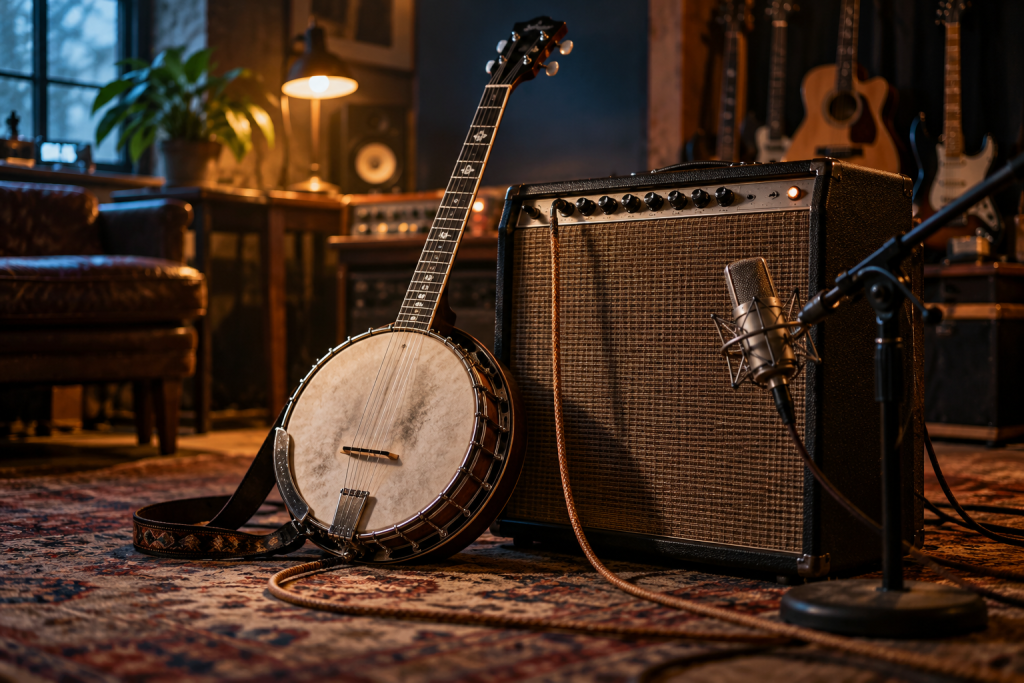
I keep a little 8-watt combo in the corner of my teaching room, and it earns its keep in ways that have nothing to do with the electric guitars leaning against the wall. The banjo goes through it more than anything else. Not for volume, and not because I think a banjo should sound like a Les Paul. I do it because an amp knows what to do with the pick attack in a way that a clean DI signal often doesn’t, and I’ve come to rely on that.
Let me tell you what actually happens when a five-string banjo meets a guitar amp, where it works, where it falls apart, and how I set it up for recording and for teaching.
The signal is hotter and stranger than you expect
A banjo pickup is not a guitar pickup, even when it fits in the same rough space. The head, the tailpiece, the metal tension hoop: all of that hardware sits right where the pickup wants to listen. What comes out is bright, fast and almost brutally articulate. On a cheap piezo under-bridge system it can lean toward the plucky, thin high end that you hear on acoustic pickup demos, which is fine solo but tiring in a mix.
Plugging that into a guitar amp does something useful immediately. The amp’s input stage and the speaker interact with those transients. The speaker cone physically cannot move fast enough to reproduce every razor edge, so it does some collective smoothing of the top. That is the whole trick. You are not fixing the tone, you are letting a paper cone and a small box round the corners off it.
What the amp is actually adding
Speaker and cab colour
I’ve found that the biggest difference between DI banjo and amped banjo is the speaker. A 10-inch driver in an open-backed cabinet pushes a little midrange bump into the 2 to 5 kHz region that just plain suits the instrument. It gives the clatter some body. The DI version sits flat and glassy by comparison, and no amount of EQ quite gets you there because the speaker is also compressing and resonating, not just filtering.
A little compression for free
Push a guitar amp into its working range and the preamp starts to sag slightly under fast transients. With banjo rolls, that reads as glue: the soft notes come up, the harsh notes come down. It’s a gentler version of what you’d get from a dedicated compressor with a fast attack, and it happens before you’ve plugged in a single plugin.
Tone controls as a filter, not a fader
Most small amps give you one tone knob. On something like the Orange Outlowd ES3, for instance, that single Shape control sweeps from reduced midrange and added brightness clockwise to added midrange and reduced brightness anticlockwise (MusicRadar’s ES3 review explains the same behaviour, and notes how quickly the extremes get thin or dark). With a banjo, I find the useful travel is tiny. Halfway is the starting point, and I make small moves. Too far clockwise and the pick noise takes over. Too far anticlockwise and the roll definition disappears. The review even suggests leaving it centered and nudging to taste, which is exactly how I treat it.
Where it falls apart
Feedback is the obvious one. A banjo head plus an amp plus a small room is a resonator doing its favourite thing. If you are monitoring through a speaker, keep the cabinet off-axis and low. This is not a stage solution.
The other issue is that guitar amps colour the low end. A banjo doesn’t have much low end to colour, but what it has can get woofy if you push volume too hard. Back off. You only need enough amp to move the speaker.
And I’ll be honest: the reverb on most small amps is not your friend here. A bright hall on a bright instrument is a recipe for mush. My own habit is to record dry when I can, and I’d rather add a small room in the DAW afterwards than commit to one in the amp.
How I set it up
- Start with all controls at noon. Not because noon is magic, but because it gives you room to move both ways.
- Use the amp’s tone control in the middle. Small nudges only.
- Push the amp to where it just starts to compress transients, then back off a touch for clean material and let it sit there for anything rhythmic.
- Keep any onboard reverb low, or off entirely for tracking.
- Mic the speaker if you have the luxury. The whole point is the cab, and a close dynamic mic a few inches off the grille captures the colour that a DI signal won’t.
When I’d recommend against it
If you need a clean, modern, high-fidelity banjo for a bluegrass cut where every note must sit precisely in the mix, skip the amp. A good pickup into a clean preamp, with some careful EQ and a modest compressor, will get you a more predictable result. The amp is a colouring tool, not a corrective one.
But if you’re after the sound of a banjo in a real room, played by a real hand, with a bit of grit and body and a natural ceiling on the top end, the guitar amp is a genuinely useful piece of the chain. I keep plugging into mine. I suspect I’ll keep doing it for a while.