The first time I recorded an upright piano properly, I got the lid open, set up a pair of small-diaphragm condensers, tracked four takes, and then spent an hour wondering why the result sounded like a cardboard box with strings in it. The problem was placement. Uprights are strange instruments to mic because the sound doesn’t come out of one obvious hole. It leaks from the top, the back, the pedals, and the soundboard, and every one of those exits has a different tone.
What follows are three positions I keep coming back to in my own room. They work with the lid up or down, they don’t need a studio full of baffles, and each one solves a slightly different problem. I’ve also included what I do when a position doesn’t work, because on an upright that happens more often than on a grand.
Why uprights are tricky in the first place
On a grand, the soundboard faces up into the open air and you can put a mic anywhere from the hammers to the tail. On an upright, the soundboard is pressed against the wall behind the piano and fires backwards. So most of the useful sound is either reflected off that wall or escaping through the top.
That single fact should guide every placement decision. If you mic the front, you’re mostly hearing the hammers and the action. If you mic the back, you’re hearing the soundboard through whatever wall is behind it. If you mic the top, you’re hearing a mix of both. None of these is wrong. They just sound different.
Position one: over the top, aimed at the soundboard
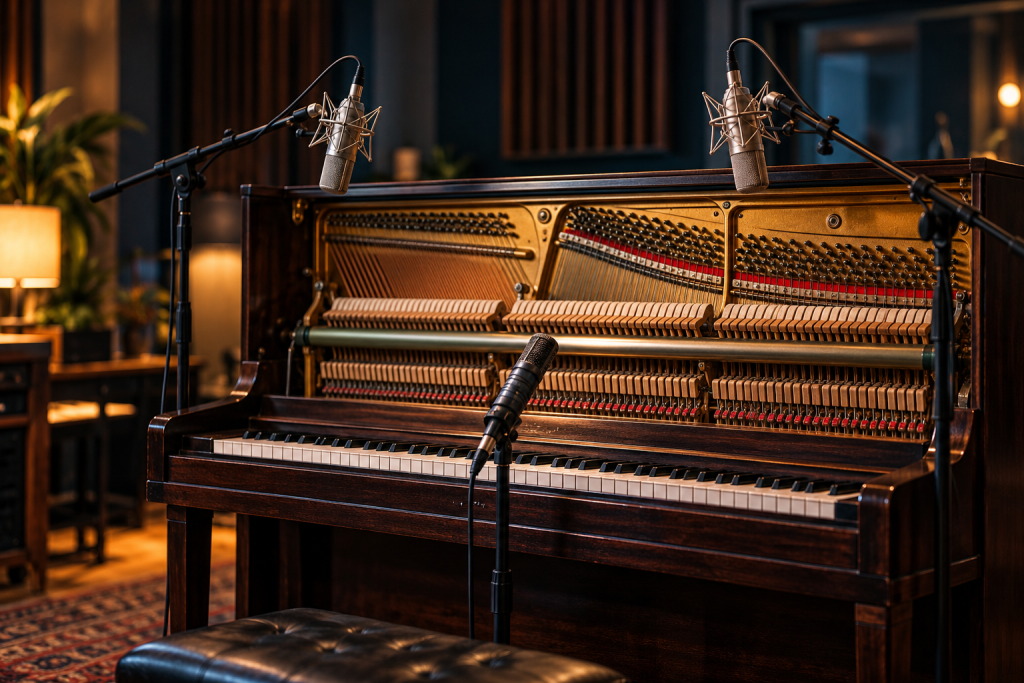
This is my default. Lid open or removed, one mic (or a pair) dropped over the top edge and angled down toward the strings and soundboard, roughly over the middle of the instrument. I start about 30 to 40 centimetres above the strings and move closer if the room is noisy, further if I want more air.
What you get here is the most balanced version of the piano. Hammer attack is present but not overpowering. The low end is intact without being boomy. It translates well to a mix because you’re capturing the instrument roughly the way a listener hears it from the bench.
Two things to watch. First, if you’re using a single mic, you’ll get a slightly lopsided stereo image when you listen back, so don’t expect a wide spread. Second, the top of an upright is a hard, reflective surface, and a mic pointed straight down will catch some of that bounce. Angling it works better than dropping it vertically.
When to skip it
If the piano is jammed into a corner and you can’t get above it, this position is off the table. Don’t force it. Move to position two.
Position two: behind the piano, listening to the soundboard
Pull the piano out from the wall if you can, even half a metre. Put a mic behind it, roughly at soundboard height, aimed at the wooden back. This is where the upright’s real body lives. The low mids fill out, the tone gets rounder, and the hammer noise drops away almost completely.
The catch is that you’re now recording the wall as much as the piano. If the wall is bare plasterboard or brick, you’ll hear reflections smearing the attack. In a treated room this position is gorgeous. In a bedroom with nothing on the walls, it can sound distant and phasey.
I use position two when I want a piano to sit underneath a vocal or a guitar, where the attack would otherwise compete. The blended, softer character is exactly what those parts need.
Position three: a spaced pair across the top
For solo piano or anything where the piano is the main event, I go stereo. Two small-diaphragm condensers over the top, spaced roughly 40 to 60 centimetres apart, both angled down toward the strings. One sits closer to the bass end, one toward the treble.
The spacing matters. Too close and the image collapses to mono. Too wide and you get a hole in the middle where the hammers live. I start at around 50 centimetres and adjust by ear, listening for whether the middle of the keyboard still feels solid.
This is the position that most rewards a decent room. If the piano is in a live space, the spaced pair will also capture the room, and that’s usually a good thing on a solo recording. If the room is dead, the pair sounds flat and clinical. Add a distant room mic if you have one spare, or accept the dryness and fix it with reverb later.
The positioning rules I apply to all three
- Move the mic, not the piano. Repositioning an upright is a two-person job. Repositioning a stand takes ten seconds.
- Record the same phrase from each position. A short chord passage plus a run. Twenty seconds is enough to hear the difference, and it stops you from choosing a position based on one lucky take.
- Watch the pedals. The sustain pedal on an upright produces a mechanical thump that close mics pick up. If it’s intrusive, angle the mic slightly away from the pedal assembly.
- Check the lid. An open lid sounds brighter and more direct. A closed lid sounds boxier but more contained. Try both before committing.
What I do when none of them work
Sometimes the piano is just in a bad spot. Pushed against a wall, no space above it, thin room. In that case I stop chasing the perfect position and accept a compromise: one mic over the top, angled toward the treble, and a second mic placed low and to the side to catch the low end. It’s not elegant, but it works in tight spaces and gives you enough material to shape in the mix.
The other option is to move the piano. If you record it regularly, it’s worth the afternoon. An upright against a solid wall with a metre of clearance behind it will out-record a grand shoved into a corner.
The takeaway
Three positions, three different pianos. Over the top is the safe, balanced choice. Behind the piano gives you body and softness. A spaced pair over the top gives you width, provided the room cooperates. Try all three on the same phrase before you commit, and trust your ears over any rule I’ve written here. The instrument in front of you will tell you which one it prefers.