The mistake most guitar players make with volume swells is treating the volume knob like a switch. Roll it up, hit the note, done. That gets you a swell the way a light switch gets you a sunset. Pedal steel players do it differently, and once I understood why, my swells stopped sounding like a guitar player imitating a synth pad and started sounding like music.
Here is the correction: on pedal steel, the volume pedal is not an effect you reach for. It is part of the instrument’s resting posture. A steel player’s foot lives on that pedal the entire night, and the hand never touches a volume knob. The pedal is a continuous thing you ride, not a gesture you perform. When I started learning steel, my teacher made me play a whole set with my foot never leaving the pedal, even on songs with no swells at all. That felt absurd for about a week. Then it rewired how I hear dynamics.
Why the foot beats the hand
Your right hand is busy. It is picking, muting, palm blocking, changing pick angle. Asking that same hand to also ride a volume knob smooths out the one motion you can least afford to blur. The foot is doing almost nothing on a six-string guitar anyway. Give it a job.
The bigger reason is ergonomic. A foot on a pedal gives you a continuous taper you can hold, adjust in tiny increments, and hold again. A pinky wrapped around a knob gives you a twist that is harder to keep linear, especially when you are also trying to keep the note alive. The foot travels in a gentle arc with far more fine control at the low end, which is exactly where swells live. You want slow, creeping control at the start of the swell and the ability to open up smoothly. A pedal gives you that. A knob fights you.
What hardware and physical work do for muscle memory is the point here. The travel of a fader, the resistance of a pedal, becomes an extension of your leg, and you stop thinking in parameters. That is the whole reason I keep a volume pedal on the floor even when the swell is subtle enough that nobody in the room notices it happened.
The habit, specifically
Here is the drill. Set your amp so the guitar is clean and loud enough that you would normally play at about six or seven on the guitar’s volume. Now back the guitar’s volume off to about eight, and put the pedal all the way down. Your resting state is silence. Play a chord or a single note with the pedal closed, then open the pedal slowly with your foot while the note rings. That is the swell.
The thing that separates a steel swell from a guitar swell is the attack. A steel player plays the note at full picking force, so the string is already vibrating properly, then opens the pedal. The note does not gradually get picked harder. It arrives fully formed and then the volume comes up around it. If you try to swell by picking softly and getting louder with your foot, you get a thin, hesitant front end. Pick like you mean it. Let the pedal hide the attack.
Do it wrong for a minute and you will hear the difference. Play a note with the pedal half open and pick it softly, then open the pedal. Compare that to picking hard with the pedal closed and opening. The second one sounds like a swell. The first sounds like a nervous beginner.
Placement in the chain
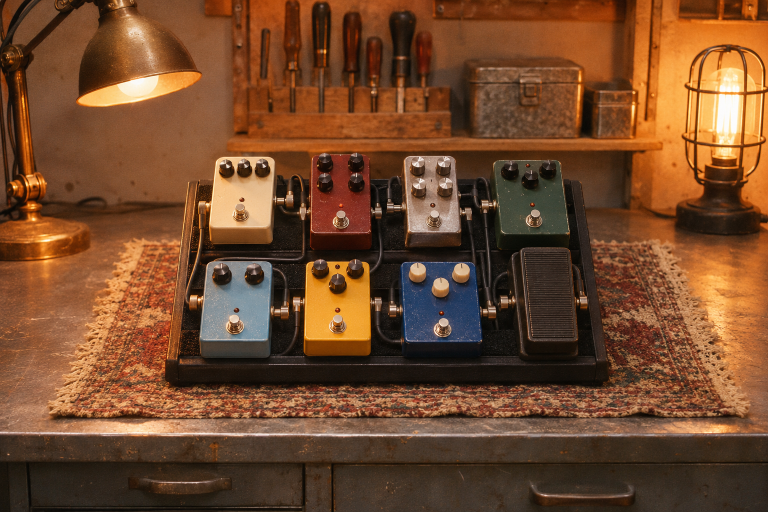
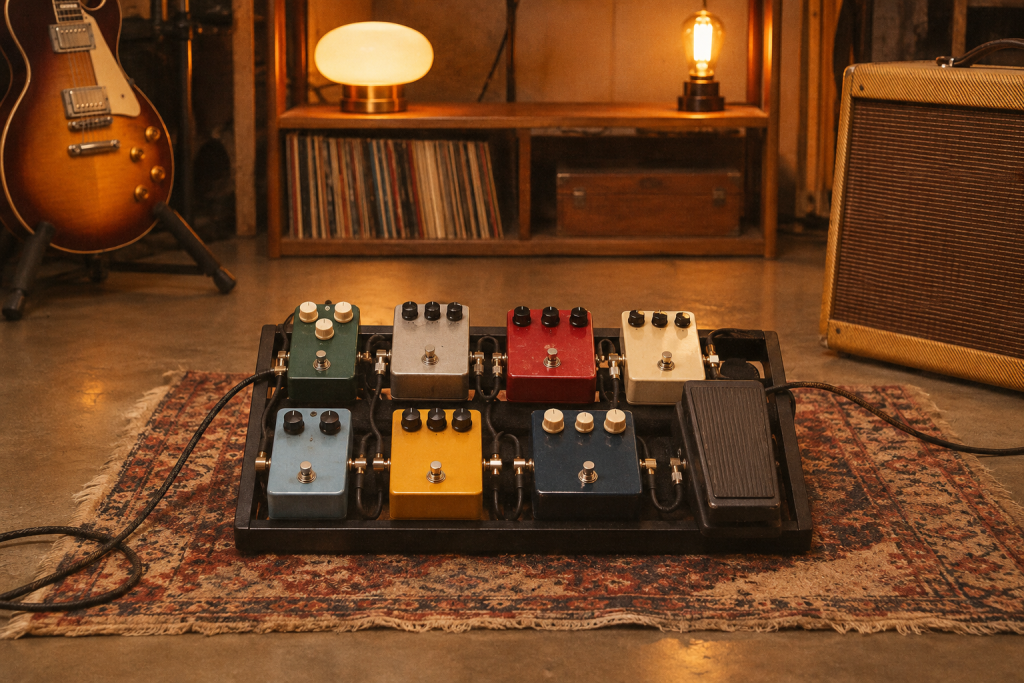
Where the pedal sits in your signal path matters more than most people expect. Put it first, straight off the guitar, and it controls everything downstream, including how hard your overdrive gets hit. That is the steel approach and it is the one I use for clean swells. As you open the pedal, you also push the front end of the amp or pedal harder, so the swell blooms into a touch more grit at the top. That can sound gorgeous. It can also sound wrong if you wanted a pristine swell the whole way.
Put it after your drives and you get a volume control that does not change how the gain stage reacts. Cleaner behavior, less bloom. For most guitar players doing pads and ambient parts, that is the safer spot. Try both with the same phrase and trust your ears over the internet’s opinion. Neither is “correct.” They are different tools.
One warning. If you run a compressor early in the chain and the pedal after it, the compressor will fight your swell by pulling up the quiet part. Put the volume pedal before the compressor or learn to live with a swell that has a floor. I learned that one the slow way during a session where the engineer kept asking why the pad sounded “squashed at the front.”
The swell shape nobody teaches
A good swell is not a straight ramp. Open the pedal a little slower at the start, then let it move faster through the middle, then ease off at the top so it does not slam into full volume. A pedal with a smooth taper lets you do this without thinking. A cheap pedal with a two-position feel makes it impossible.
I also close the pedal slightly before the note ends, on purpose, so the tail tapers away instead of stopping. Steel players are ruthless about this. The note should arrive from nothing and leave into nothing, and the pedal handles both ends. Most guitar players only think about the front.
Try swells on sustained chords rather than single notes. The pedal reveals how uneven your chord voicing is, because a badly balanced chord sounds lumpy as it opens. That is feedback, not failure. Fix the balance and the swell smooths out.
What to buy, and what not to
You do not need a boutique pedal to start. A basic passive volume pedal with a decent taper will teach you the habit better than an expensive one with features you will not touch. What you want to avoid is a pedal with a cheap pot that gets scratchy, because a scratch in the taper is audible on every swell you play. Test any pedal with slow, continuous sweeps before you buy it. If you hear crackle or a dead zone near the bottom, walk away.
Active pedals with a buffer solve the tone-loss problem you get with long cable runs, but they color the signal a little. Try your setup both ways. The guitar-to-pedal-to-amp chain on a short run usually does not need it. The 30-foot cable run across a stage probably does.
And keep the pedal under your foot even when you are not swelling. That is the habit. Steel players do not deploy the pedal, they live on it. Once your foot rests there by default, you will find swells sneaking into parts where you never planned them, and the whole thing starts to feel like part of your playing rather than a trick you pull out for the ballad.