Most mallet instrument plugins give themselves away in the first three notes. The attack is a click, the body is a sine wave someone tuned, and by the time you play a roll it sounds like a keyboard pretending to be wood. Marimbox comes at it from the opposite end: Hivetune built it on real stereo marimba recordings and put the phrase shaping in front of the samples rather than behind them. Free is the least interesting thing about it, but it is what will get people to try it, so I’ll explain why the recording method is the part that actually holds up in a session.
What is actually in it
Marimbox is a sampled marimba instrument, not a synthesizer impersonating one. The core is stereo sample material, which means the bar attack, the resonance of the resonator tubes, and the room all arrive as a matched picture instead of being rebuilt from a single mono hit and a reverb send. I can hear the difference most clearly on repeated notes. With a synthesized marimba, two hits on the same bar sound like two copies of one file. Here the stereo field moves slightly between strokes, because a real player’s mallet doesn’t land in exactly the same spot, and the pair of mics picks that up.
That is not a marketing detail. It changes how the instrument sits under a guitar or a piano. A marimba that’s a single point source fights to be located in the mix. A stereo one occupies a width, and width is what lets it stay out of the way.
Why the recording matters more than the feature list
I keep coming back to one thing when I judge sampled instruments. Does the sample contain the transient, or does the interface create it? If the attack has to be faked with a volume envelope, rolls fall apart. Every note starts from silence, and a fast shake becomes a stutter of restarts instead of a continuous sound. Real marimba rolls depend on the bars ringing through each other. The mallets strike, but the instrument keeps talking.
Because the source here is recorded stereo, the tail of one hit is still in the sample when the next one begins. Play a tremolo and it behaves like the instrument, not like a keyboard. That’s a property of how it was captured, and no amount of clever scripting can add it afterwards.
The same logic explains why the stereo picture stays stable across the keyboard. A synthesized model often has to pan notes by pitch to fake an instrument’s width, which is why extreme low and high notes can drift off to one side. Sampled stereo keeps its position, so a low ostinato and a high melody share one coherent space.
Using it where a marimba usually doesn’t go
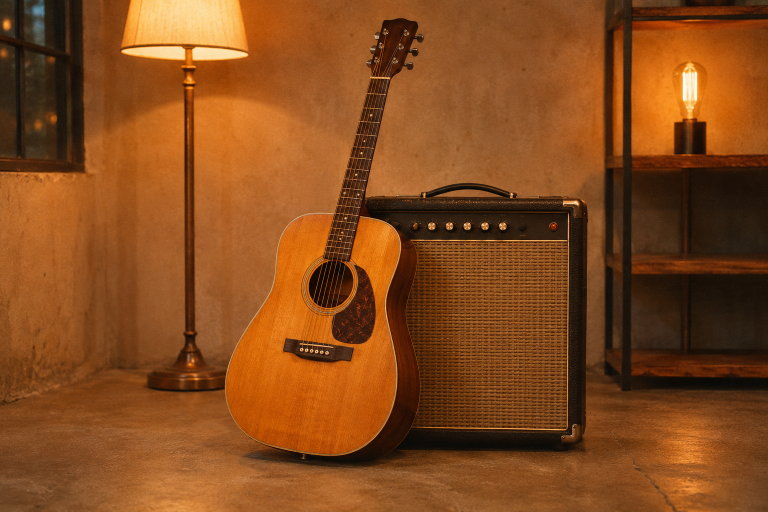
I record guitar, piano and banjo, so a marimba is not my natural instrument. That’s exactly why a plugin like this earns its keep. When I want a mallet texture under a fingerpicked guitar, I don’t want to program one. I want to play a line and hear it respond. The attack on the real bars is soft enough to sit under a steel string without covering the pick noise, which is something I can’t get from a hard, bright synthetic mallet.
Under a piano
On a track with close-miked upright, a marimba doubles the top line an octave up and the stereo field stops the two instruments colliding. The recorded room on the marimba gives it a slightly distant feel, which is a good counterweight to a piano that’s all hammers and no air.
Under banjo
Banjo has a fast decay and a lot of midrange bark. A marimba playing the same figure at half the rhythmic density fills the gaps the banjo leaves without adding another bright transient. I keep the marimba low in the mix and let the stereo width do the work.
As the lead
Played alone, the recorded character is clear enough to carry a piece. The bar tone is woody and the resonator adds a slight bloom below the fundamental. If you’re used to synthesized mallet sounds, this will feel less polished and more physical. That’s the point.
Where it will frustrate you
Recorded instruments come with recorded limitations. A sample set is fixed at the velocities and articulations that were captured, so if you want a hard mallet on a soft bar, or a dead stroke, you may not find it. Synthesizers let you dial those in. Marimbox gives you the sound of a real player, and real players have a range. Push past the loudest captured layer and the instrument will either cap out or start to sound like it’s straining, depending on how the mapping was done.
It’s also a specific instrument, not a mallet workstation. If you need vibraphone, xylophone, or glockenspiel, you’ll need something else. Hivetune built a marimba, so a marimba is what you get.
And the obvious one: free plugins rarely come with a support contract. If a future host update breaks it, you wait. That’s the trade when the price is zero, and it’s the reason I keep the plugins I depend on in a separate folder I can freeze. It doesn’t stop me using free tools on paid work.
Does free mean worse?
A good EQ does its job quietly, and the same holds for whatever sits earlier in the chain. A well-recorded sample library doesn’t become worse because the price is zero. Where paid instruments usually lead is in deep round-robin sampling, many velocity layers, and interfaces that let you make decisions quickly. Those matter for a solo marimba concerto. They matter much less when the instrument is one layer under fingerpicked guitar.
My honest rule: if a free instrument’s samples were captured with the same care as a commercial one, use it. Judge it by whether a roll survives a fast tempo and whether the stereo image holds together under a piano. Marimbox passes both. The price is a bonus, not a warning.
What I’d want next
More captured dynamics, and clearer documentation of what velocities the samples actually cover so I can program intelligently rather than guessing. I’d also like a way to know how the stereo pairs were placed, since that tells me how wide the instrument will be before I commit it to a mix. Behind the controls, the philosophy is the one I trust: capture the room, capture the transient, then get out of the way. Hivetune did the recording properly, and the recording is what does the playing.
I’ll keep it installed next to the piano and the guitar chain. Not because it was free. Because when I hit a roll, the bars keep ringing.